

ANNUAL PARADE OF THE NEW YORK FIRE DEPARTMENT, PASSING AROUND UNION PARK.
Gleason’s Pictorial Drawing-Room. Companion [August 23, 1851]

RECEPTION OF FIREMEN BY THE MAYOR, COMMON COUNCIL, ETC., IN FRONT OF THE CITY HALL, NEW YORK.
Gleason’s Pictorial Drawing-Room. Companion [August 23, 1851]

DUQUESNE FIRE COMPANY, OF PITTSBURG, PASSING THE GIRARD BANK, PHILADELPHIA.
Gleason’s Pictorial Drawing-Room. Companion [September 6, 1851]
“…At Broad and Market streets they were received by a large body of firemen, and taken in the especial charge of the Good Intent Hose Company. The escort formed in Market street, right on Broad, and as soon as the guests arrived with their apparatus, the line was formed and proceeded over the route in the following order : — Gaul's Brass Band, Hibernia Engine Company; Beck's Philadelphia Band, Hope Hose Company ; Washington Brass Band, Harmony Engine Company ; Pennsylvania Cornet Band, Committee of the Good Intent Hose Company ; Duquesne Fire Engine Company, from Pittsburg, with 33 members, dressed in black pants, blue coats and capes, and red hats. The guests carried a blue and straw colored banner, handsomely wreathed ; Good Intent Hose Company with the Duquesne apparatus, drawn by four black horses ; Band, Reliance Engine Company ; Northern Liberty Hose Company ; Navy Yard Band, Franklin Engine Company ; Mechanics' Brass Band, Weccacoe Engine Company, etc., etc …”

BOSTON BRASS BAND
Gleason’s Pictorial Drawing-Room. Companion [September 20, 1851]
“Our city has for a long period of time, been noted for the excellence of its military bands of music, and they have enjoyed a reputation, far and near, for the extraordinary harmony, and correct musical performance they have always exhibited when in public. In only two instances have we ever heard our Boston bands excelled in those points of beauty that appertain to their profession, and these were listening to the governor general's military band, in the plaza of Havana, and the second time, on hearing Dodworth's famed band of New York city. The engraving which we present herewith, represents the Boston Brass Band, more familiarly known as Flagg's Brass Band ; and we consider it a faithful and spirited picture, as they appeared when sketched by our artist. This band claims priority over all others in this, or any other city of the Union, as being the first association of the kind in the country, being first organized in 1835, under Edward Kendall, the far-famed bugle player, as its leader. Joseph Green, the present efficient and popular leader of the American Brass Band, at Providence, R.I., was the next to succeed Mr. Kendall. Its present head is Eben Flagg, who has led the band for some eight years and more, sustaining an excellent reputation, no less for his professional skill than for his manly and sociable qualities. The members of the Boston Brass Band are composed mainly of professors, musical composers, and artists, each one highly accomplished in the use of his particular instrument. This favorite band have just adopted a new and very beautiful uniform, consisting of a blue frock coat, red pants, and a blue infantry cap, with fountain plume. A very important improvement has lately been made by the band, in the construction of their new set of instruments. It is, and has long been a source of no little trouble to military men to keep the time and spirit of the band's performance for the ordinary purposes of time, and the exhilarating effect that good music imparts. The reason of this is the fact that the mouths of their instruments almost invariably open from the company, so that persons ahead are far better regaled by the music than the company behind them. The improvement referred to in the new instruments of the Brass Band, is the adoption of a new set throughout, with the bells all opening back, and pointing over the shoulders of the performers, giving the company the great advantage of hearing every note of each instrument. Those who have marched in the ranks, know how to appreciate this advantage, and the band have found it to administer to their pecuniary good, as well as general popularity. The Atlantic cities are now well supplied with excellent bands of music, formed by men whose genius or education have made them distinguished in performance upon instruments more or less difficult to master as professors. As our military companies increase, churches are built, and ball-rooms are opened, may we not hope soon have our own composers? The scoring of parts for these bands will make a good national school for American musical genius.”

VIEW OF THE TEMPORARY ENCAMPMENT OF THE BOSTON CADETS, AT NAHANT.
Gleason’s Pictorial Drawing-Room. Companion [September 20, 1851]
“The view given above represents the encampment of the Boston Independent Cadets, at Nahant, as it appeared there a few weeks since. The picture is scrupulously correct, and was sketched by our artist at the hour when the band were performing at the entrance of the camp. This superior corps of citizen soldiery requires no eulogium at our hands, having long sustained a most distinguished reputation in the State. There are many attractions about Nahant which render it a delightful resort for parties on excursions of pleasure or discipline.”

WORCESTER CITY GUARDS, ON EVENING PARADE, IN FRONT OF THE EXCHANGE BUILDING, WORCESTER, MASS.
Gleason’s Pictorial Drawing-Room. Companion [November 8, 1851]
“…Flagg's Brass Band accompanied the Guards, and discoursed most eloquent music during the day and after the removal of the cloth at table…”

WINTHROP LIGHT GUARDS, OF BOSTON, RECEIVED AT SALEM BY THE SALEM CITY GUARDS.
Gleason’s Pictorial Drawing-Room. Companion [November 8, 1851]

SPLENDID PANORAMIC VIEW OF THE GRAND PROCESSION OF THE MILITARY, AND ARTS, TRADES, SOCIETIES, AND PROFESSIONS, ON THE OCCASION OF THE GREAT RAILROAD JUBILEE, IN BOSTON, SEPTEMBER 19, 1851
Gleason’s Pictorial Drawing-Room. Companion [November 15, 1851]

THE MILITARY DIVISION OF THE MAIN PROCESSION PASSING OUR OFFICE IN TREMONT STREET.
Gleason’s Pictorial Drawing-Room. Companion [November 15, 1851]

THE CELEBRATED DODWORTH’S NEW YORK CORNET BAND
Gleason’s Pictorial Drawing-Room. Companion [January 18, 1852]
“The fame of this justly celebrated band is too widely extended to call for any eulogium from our pen. We should impugn the intelligence of our readers were we to enlarge ujjon their talents as composers, or the chasteness and elegance of their performance as musicians. We content ourselves, therefore, with presenting portraits of the father and four sons, composing the Dodworth family, together with a slight sketch of their history, and also a representation of the five different uniforms worn by the band. These illustrations were drawn from daguerreotypes taken expressly for us ; and we feel assured we could not better please our readers than by introducing to them the world-renowned Dodworth’s. In 1828, Mr. Thos. Dodworth the father, and Allen, the eldest son — then about ten years of age — attached themselves to what was afterwards known as the Castle Garden Band, Thos. Dilks, leader. Three years after this. Harvey, the second son, then nine years of age, also joined the band. It will be seen by this, that three of the family have been practical musicians for upwards of twenty years. Some misunderstanding occurring in the old band, the Dodworth’s and some five or six others separated and formed the original Dodworth's Band, under the title of the National Brass Band — the father playing base, Allen the trombone, and Harvey the fife. The new band met with much opposition and but indifferent success ; and on several occasions were dismembered by the machinations of others. On one occasion, their principal bugle player left them only three days previous to an important engagement which it was impossible to break. Without being disheartened, however, Allen offered to fill his place. A new E flat bugle was procured, and with only three days' practice he performed to the satisfaction of all parties. To those who understand the difficulty of changing from a large to a small mouth-piece, this will appear the more extraordinary, especially when we consider the youth of the performer. Shortly after this occurrence, Charles and Thomas, the third and fourth sons, became members, thus filling all the solo instruments ; and it was only necessary to add the secondary instruments to form a complete band. In 1839, they made their first important improvement by the introduction of an entirely new class of valve instruments, which they called the Nova eber corno, or New York Horn ; the first that was made being a tenor, and filling up the middle harmony, which before had been quite deficient. Then followed bases, sopranos and altos, making the complete set, as now used. About five years after this introduction by the Dodworths, the saxhorn — which is the exact counterpart of their eber corno, and precisely the same arrangement — made its appearance in Europe, and made a complete revolution in the organization of the brass band ; proving that, at least, a singular coincidence ideas had taken place. The second great, and certainly a most important, improvement was the adoption of an entirely new set of instruments with their bells directed over the shoulders, the great advantage of which will at once be seen by any one who has ever marched behind a band. The sound, by this arrangement, is directed toward the company, instead of from it, as was previously the case. This arrangement has since been adopted by many other bands, who previously ridiculed the innovation ; and who, with becoming consistency, refuse to give the credit where it so justly belongs. At this time, the name of the band was changed to their present title: and their success from that period has been constant and unvaried ; they now rank as the best band of its size in the Union. No exertion or expense has been spared to attain this proud position. Their five different and magnificent uniforms have been purchased at their individual expense: and they are now having manufactured a new and beautiful set of silver instruments with improved valves which, when complete, will no doubt be one of the most magnificent set of instruments ever made. All their music is composed or arranged by members, but principally by Allen or Harvey ; some of whose compositions have become widely and justly popular. For concerts or balls, an entire change of instruments is made — violins, flutes, clarinets, etc., being introduced — making out of the same number of men a very efficient orchestra. It is only necessary to .show their popularity, to state that their engagements during the past summer have extended over the States of New Hampshire, Vermont, Massachusetts. Connecticut, New York, Pennsylvania, Maryland. Virginia and Ohio ; and they show, among other testimonials, a beautiful silver goblet presented them by the Hartford Light Guard, on the occasion of Gov. Seymour's inauguration, a splendid base drum by the City Blues, of New York, and a magnificent gold medal by the New York Light Guard, on the 25th of November last, when the band paraded for the first time, 35 men, in their new Hungarian over-coat. Their popularity is widely extended among all classes of the community, and they are frequently cheered by the crowd as they pass. They were engaged to attend all the banquets given in honor of Kossuth ; and, in fact, whenever an extra occasion calls for good music, Dodworth's band is the ne plus ultra. May their shadow never be less. The band, at present, consists of twenty members.”

THE CELEBRATED DODWORTH FAMILY OF NEW YORK
Gleason’s Pictorial Drawing-Room. Companion [January 18, 1852]

VIEW OF THE LINE OF PROCESSION AS IT APPEARED ESCORTING GOVERNOR KOSSUTH TO THE CAPITOL OF THE STATE OF MASSACHUSETTS
Gleason’s Pictorial Drawing-Room. Companion [May 15, 1852]

THE COLUMBIAN ARTILLERY, BOSTON
Gleason’s Pictorial Drawing-Room. Companion [July 10, 1852]

PROCESSION, AND GRAND RECEPTION OF THE HON. DANIEL WEBSTER IN BOSTON.
Gleason’s Pictorial Drawing-Room. Companion [July 31, 1852]

GRAND REVIEW OF TROOPS IN THE PARK, NEW YORK.
Gleason’s Pictorial Drawing-Room. Companion [September 25, 1852]

EXHIBITION OF THE HORTICULTURAL SOCIETY, AT MONTREAL, CANADA.
Gleason’s Pictorial Drawing-Room. Companion [November 20, 1852]
“…A large number of visitors were attracted to the exhibition, who appeared much delighted with the specimens of fruits, vegetables, which were there presented, while the splendid band of the 20th Regiment (English) enlivened the occasion with its fine music…”

UNIFORM OF THE MARINE CORPS OF THE UNITED STATES NAVY.
Gleason’s Pictorial Drawing-Room. Companion [January 22, 1853]

REPRESENTATION OF THE ROVER GUARDS, OF CINCINNATI, OHIO.
Gleason’s Pictorial Drawing-Room. Companion [April 30, 1853]
“…The company has now eighty enrolled members, besides a full brass band of sixteen instruments, combining the best musical talent of the city…”

PILGRIM CELEBRATION AT PLYMOUTH, MASS., AUGUST 1, 1853.
Gleason’s Pictorial Drawing-Room. Companion [August 20, 1853]
“It was headed by a military escort, composed of the following companies: the Standish Guards, Capt. Churchill, of Plymouth, led by the Boston Brigade Band ; the Abington Artillery, Capt. Thomas Bates, accompanied by the South Abington Brass Band; the Halifax Light Guard, Capt. Sumner; the Samoset Guards, Capt. Bumpus, of Plimpton; the Independent Boston Cadets, Col. Amory commanding. Following the Cadets were the New York Light Guard, Captain Vincent, escorting the delegation from the New England Society of New York city, Vice President Simeon Draper at their head. The whole arrangement of the military escort was in the highest degree admirable, and the spirit-stirring notes from the accompanying bands, as they alternated with each other, produced a very pleasing variety of music…”

FIRST DIVISION OF MASSACHUSETTS VOLUNTEER MILITIA, PASSING IN REVIEW, AT NORTH ABINGTON.
Gleason’s Pictorial Drawing-Room. Companion [September 10, 1853]
The parade depicts events of an encampment that took place in North Abington, Massachusetts from August 16-18, 1853. The article makes little mention of the bands even though two are depicted in the engraving.

BANNER PRESENTATION TO THE "BOSTON ASSOCIATION," AT NEW YORK
Gleason’s Pictorial Drawing-Room. Companion [December 24, 1853]
“…Music was served by Shelton's band…”

DINNER OF JAPANESE OFFICERS ON BOARD U. S. SHIP POWHATAN.
Ballou's Pictorial Drawing-Room Companion [November 17, 1855]

PROMENADE CONCERTS ON BOSTON COMMON.
Ballou's Pictorial Drawing-Room Companion [August 16, 1856]
“During the present season, our beautiful Common has been rendered doubly attractive, on fine evenings, by the performance of excellent music by our principal bands, which are not surpassed by those of any city in the Union. The practice was inaugurated many years ago, and after an interval, resumed some summers since. Our artist, Mr. Champney, has sketched the scene presented on the hill near th epoind on one of these occasions. In the centre of the picture, among the trees, are the staging and the band. Grouped around the base, standing, or promenading, are representatives of all classes of our population. There are the Beacon Street millionaire and the Boston mechanic, the servant girl out on leave of absence with her beau, and the belle with her accepted, old gentlemen and young gentlemen, nursery maids with children in little hand-carriages, and schoolboys almost too young too [sic] frolick-some to attend to the music. Barring a little noise from the juveniles, which must be expected, the utmost order and decorum prevail, and there are unmistakable influences of the power of music in the hushed attention which enchains the multitude during the performance of some fine piece, and the rapturous applause that bursts forth at its close. The example of Boston has been imitated in some of the suburban settlements. Indeed the performance of music on summer evenings in public places has become quite common in our large towns, and we have no doubt thar in a few years we shall rival Germany in this respect.”

VIEW OF WASHINGTON STREET, HOBOKEN, NEW JERSEY
Ballou's Pictorial Drawing-Room Companion [September 27, 1856]
“…That in our view the principal sweet. The prominent buildings delineated are the Odd Fellows Hall and one of the armories. In front of the latter, a New York city company, on a target excursion, accompanied by Dodworth's band, is halted…”

THE GREAT BOSTON HORSE EXHIBITION, AT THE AGRICULTURAL FAIR IN BOSTON, OCTOBER, 1856.
Ballou's Pictorial Drawing-Room Companion [November 29, 1856]

RETURN OF THE CHARLESTOWN CITY GUARD FROM WASHINGTON.
Ballou's Pictorial Drawing-Room Companion [April 18, 1857]
"...As the train containing the Guard entered the depot, the Brigade Band (including Ned Kendall) played the beautiful melody, "Home, Sweet Home," with fine effect...In the evening a "citizen's Reception Ball" was got up at City Hall...The music was furnished by the Germania Band..."

REVIEW OF THE NEW YORK SEVENTH REGIMENT, ON BOSTON COMMON.
Ballou's Pictorial Drawing-Room Companion [July 4, 1857]
“…On the right is the magnificent regimental band whose appearance and performances excited so much enthusiasm, with their drum-major attired in the gorgeous and conspicuous style of the French service…The military now are more popular than ever.”

A GERMAN DANCE ON THE FOURTH
Harper’s Weekly [July 4, 1857]

A TARGET EXCURSION IN BROADWAY
Harper’s Weekly [October 23, 1858]
“[REPORTED BY OUR FRENCH CONTRIBUTOR] … In front promenade the divine band of your Dodworth, with a most grand man in front, six and a half foot at least, and a leg of much force. He wave his lef, and he wave his arms until, mon Dieu! I was much afraid they should come off; but they never do. The band played Yankee Doodle, and La Marseillaise, and Hail Columbia, and Guerre aux Tyrans, and the small boys they was touch by the music, and they cry, "Go it, Mose!" which I suppose, is Yankee for encore ... "

THE ALABAMA STATE FAIR- THE AMPHITHEATRE
-FROM A SKETCH BY NIXON
Harper’s Weekly [November 27, 1858]

INAUGURATION OF GOVERNOR MORGAN-GOVERNOR KING PROCEEDING TO THE CAPITOL.
Harper’s Weekly [January 15, 1859]
“ ... At noon, on New Year's Day the Albany Burgesses Corps, commanded by Capt. Spelman, and attended by Scrieber's band, escorted Governor elect from his residence to the Capitol. They numbered 57 musekets, and were a fine-looking body of men … ”

RECEPTION OF THE ENGLISH PRINCE, ALFRED, BY THE AUTHORITIES AT MALTA.
Harper’s Weekly [February 5, 1859]

THE GRAND REVIEW AT CAMP MASSACHUSETTS, CONCORD, SEPTEMBER 9, 1859.
Harper’s Weekly [September 24, 1859]

VIEW OF BROADWAY, OPPOSITE FULTON STREET, NEW YORK
Harper’s Weekly [February 18, 1860]
“The scene represented in the large picture on the preceding pages will at once be recognized by every one who was visited New York. Broadway, opposite Fulton Street, is, in its way, the most striking place in the United States. No other spot conveys so good an idea of the bustle and the stir of the great commercial city of America ... But when snow has fallen, and has begun to melt; ... the brass horns on the Museum balcony, ... the scene then becomes one to be never forgotten. As such we hand it down to posterity.”

REVIEW OF THE SEVENTH REGIMENT N.Y. STATE MILITIA BY BRIGADIER GENERAL HALL AT CAMP SCOTT ON THE RICHMOND CLUB GROUNDS, STATEN ISLAND, ON JULY 11
Harper’s Weekly [July 21, 1860]
“... The usually great feature of the day is the evening parade and guard-mounting. Arriving at 5:30 P.M., I found the troops assembling in the various streets in front of their tents, being formed by their respective orderlies. The band, consisting of over thirty men, were on the parade-ground, preparatory to formation of the regiment ... The parade and drill occupied something more than an hour; and what with the...beautiful music from the band...was worthy of the encomiums and plaudits lavished upon it by the spectators.
Evening parade being dismissed, the men retired to their tents to reclothe themselves in fatigue...At sunset, the engineer corps assembled at the flag-staff and fired the evening gun, at the same time that the ensign was lowered, and saluted by the band as it came down. Supper followed. The band played "Peas upon the Trencher;" whereupon the regiment assembled, and marched to the large mess-tent in the rear of camp...”

GENERAL MCGOWAN ADDRESSING THE ABBEVILLE VOLUNTEERS IN FRONT OF THE CHARLESTON HOTEL
Frank Leslie’s Illustrated Newspaper [February 23, 1861]

SOLDIERS ENCAMPED ON THE BATTERY AT ANNAPOLIS, MD.
-From a sketch by our special artist
Frank Leslie’s Illustrated Newspaper [May 18, 1861]
While this image does not necessarily depict a band, it does show brass instruments leaning against a bass drum.


ARRIVAL OF THE NEW YORK SEVENTY-FIRST REGIMENT AT THE RAILROAD DEPOT, WASHINGTON D.C.
- From a sketch by our local artist
Frank Leslie’s Illustrated Newspaper [May 25, 1861]

SERVICE BY REV. DR. WESTON, CHAPLAIN OF THE SEVENTH REGIMENT, AT CAMP CAMERON, ON SUNDAY, MAY 5, 1861 - Sketched by our Special Artist
Harper’s Weekly [May 25, 1861]

SCOTT. YORK. PENNSYLVANIA. OCCUPIED RY PENNSYLVANIA AND OHIO VOLUNTEERS
-Sketched by Jasper Green
Harper’s Weekly [May 25, 1861]

THE GUTHRIE GRAYS MARCHING THROUGH CINCINNATI EN ROUTE FOR CAMP DENNISON
- SKETCHED BY MR. NOBLE, OF CINCINNATI
Harper’s Weekly [June 8, 1861]

REVIEW OF THE NEW YORK TROOPS AT WASHINGTON, BY GENERAL SANDFORD, IN PRESENCE OF THE PRESIDENT AND CABINET, JULY 4, 1861
Harper’s Weekly [July 27, 1861]
There is a depiction of a band standing on the right side of the image as well as marching in formation towards the left.

MARKET-PLACE AT WINCHESTER RENDEZVOUS OF THE REBEL MILITIA OF THE VALLEY OF THE SHENANDOAH
Harper’s Weekly [September 7, 1861]
There are a group of musicians on the left of the image holding snare drums and a bass drum. The soldiers around the drummers do not appear to be holding rifles, so it is possible that they are the brass band for the regiment.

CROSSING THE MANASSAS GAP RAILROAD, AND THE ALEXANDRIA AND WARRINGTON TURNPIKE, AT WHITE PLAINS - ARRIVAL OF REINFORCEMENTS FOR BEAUREGARD, AT THE CAMP OF THE TIGER ZOUAVES OF LOUISIANA
Harper’s Weekly [September 28, 1861]

THE GREAT REVIEW AT BAILEY’S CROSS ROADS, VIRGINIA
Harper’s Weekly [December 7, 1861]

GRAND REVIEW OF GENERAL BURNSIDES EXPEDITIONARY FORCE AT ANNAPOLIS, DECEMBER, 1861.
Harper’s Weekly [January 18, 1862]

EXECUTION OF PRIVATE LANAHAN, OF THE REGULAR ARMY, FOR MURDER, AT WASHINGTON.
-Sketched by Mr. A. Waud
Harper’s Weekly [January 25, 1862]

RELEASED PRISONERS RETURNING TO THE CAMP OF THE THIRTY-FIRST REGIMENT NEW YORK VOLUNTEERS (FRANKLIN'S DIVISION), FROM RICHMOND, VIRGINIA
-Sketched by Mr. A.R. Waud
Harper’s Weekly [February 1, 1862]

SUNDAY AT GENERAL MCCLELLAN’S HEAD-QUARTERS - DIVINE SERVICE IN CAMP
-Sketched by Mr. A.R. Waud
Harper’s Weekly [August 16, 1862]

RECRUITING IN PHILADELPHIA FOR THE BUCKTAIL PENNSYLVANIA REGIMENT
- From a sketch by our artist
Frank Leslie’s Illustrated Newspaper [September 6, 1862]

ARRIVAL AND DEPARTURE OF NATIONAL SOLDIERS ON THEIR WAY TO WASHINGTON AT THE UNION VOLUNTEER REFRESHMENT SALOON, CORNER OF WASHINGTON AND SWANSTON STREETS, PHILADELPHIA
- From a sketch by our special artist, Mr. F.H. Schell
Frank Leslie’s Illustrated Newspaper [September 27, 1862]

RETURN OF THE CINCINNATI MILITIA AFTER THE RETREAT OF THE REBELS
- SKETCHED BY MR. H. MOSLER
Harper’s Weekly [October 5, 1862]
“…At three o'clock three of the regiments marched to the head-quarters of General Wallace, in Covington, preceded by the United States Barracks Band. …”

THE FEDERAL ARMY UNDER GENERAL GRANT TAKING POSSESSION OF VICKSBURG JULY 4, 1863
Frank Leslie’s Illustrated Newspaper [August 15, 1863]

FUNERAL OF THE LATE CAPTAIN CAILLOUX, FIRST LOUISIANA VOLUNTEERS (COLORED)
- Sketched by a Native Guard
Harper’s Weekly [August 29, 1863]
“By far the largest funeral procession that has been seen on our streets since the burial of Colonel Charles Dreux, the first rebel Louisiana officer that was killed in this war, was that of Captain Andre Cailloux, of the First Louisiana Native Guards...After a short pause, a sudden silence fell upon the crowd, the band commenced playing a dirge, and the body was brought from the hall on the shoulders of eight soldiers... Captain Cailloux was a native of this city, aged 43 years, and was one of the first to raise a company under the call of General Butler for colored volunteers.”

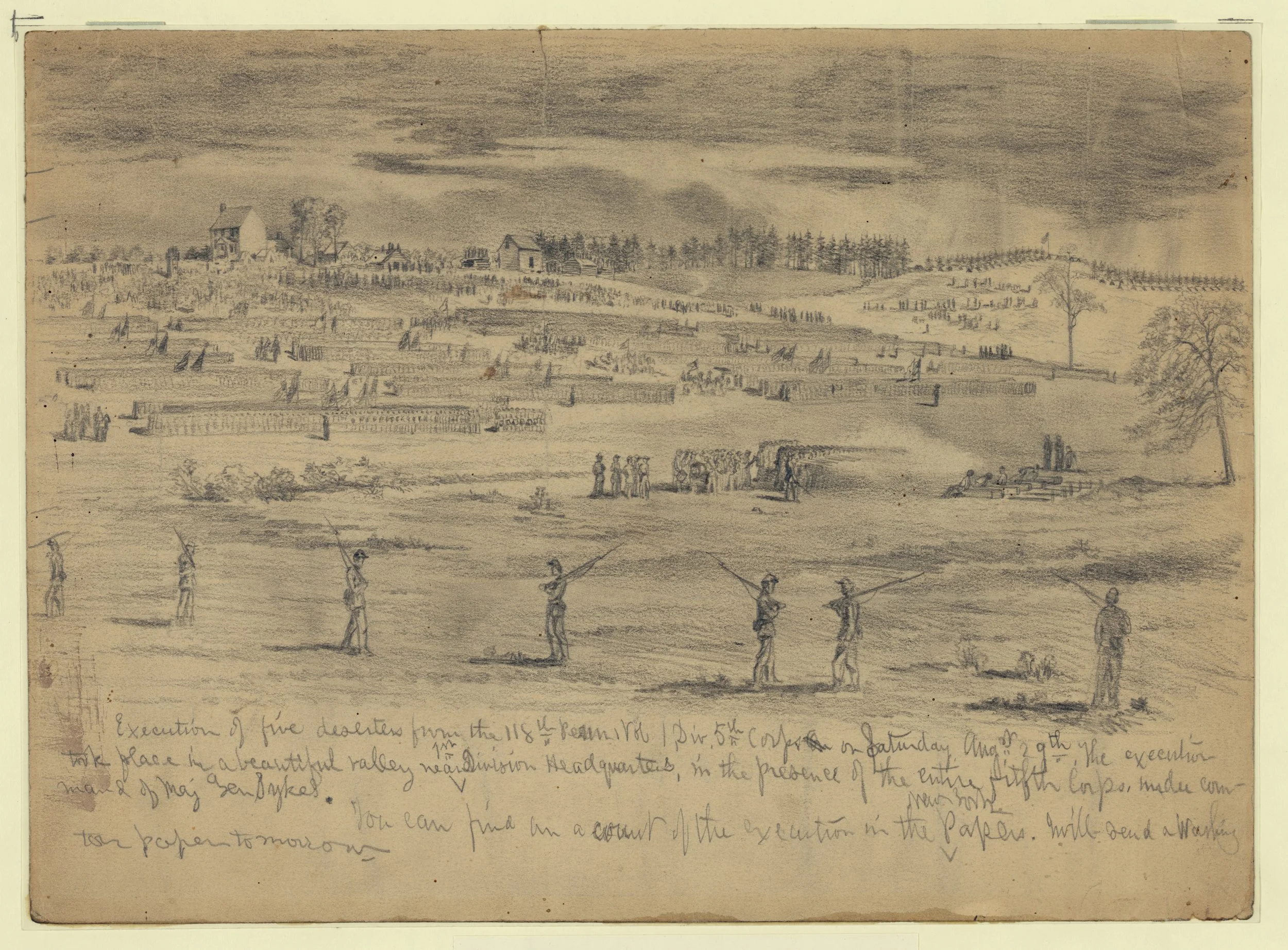
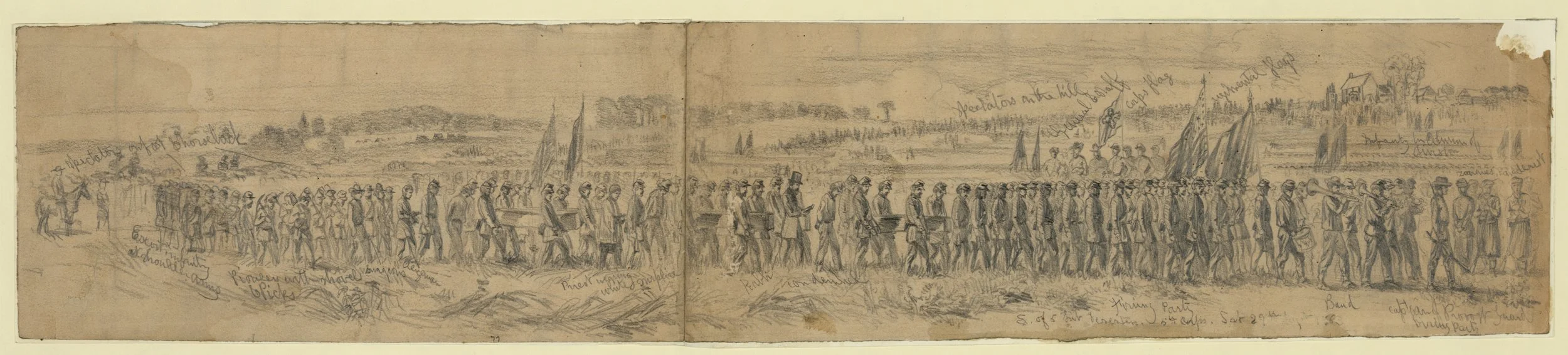
THE ARMY OF THE POTOMAC - EXECUTION OF FIVE DESERTERS IN THE FIFTH CORPS
- Sketched by Mr. A.R. Waud
Harper’s Weekly [September 26, 1863]
2 bands are visible in the newspaper engraving on the left.
“The crime of desertion has been one of the greatest drawbacks to our army. If the men who have deserted their flag had but been present on more than one occasion defeat would have been victory, and victory the destruction of the enemy...Some of these had enlisted, pocket the bounty, and deserted again and again...the procession moved to a funeral march...”
Two sketches of the same event that also depict the band are linked below.

THE TWENTIETH UNITED STATES COLORED TROOPS RECEIVING THEIR COLORS ON UNION SQUARE, MARCH 5, 1864
Harper’s Weekly [March 19, 1864]
There is possibly a small band standing just inside the square formation on the left side of the image.

GENERAL SHERMAN REVIEWING HIS TROOPS AT SAVANNAH
- Sketched by William Waud
Harper’s Weekly [February 11, 1865]

THE TRIUMPH IN NEW YORK - THE PROCESSION PASSING AROUND THE SOUTH END OF THE PARK
Harper’s Weekly [March 25, 1865]

THE TURNER FESTIVAL AT CINCINNATI, OHIO, SEPTEMBER 4, 1865 - THE PROCESSION.
-Sketched by H. F. Farny
Harper’s Weekly [September 30, 1865]

CENTRAL PARK, NEW YORK - MUSIC ON THE LAKE
- DRAWN BY W.W. WAUD
Harper’s Weekly [October 14, 1865]
This image depicts a band on a covered boat performing on the lake in Central Park

THE GREAT SKATING “RINK” AT CHICAGO
Harper’s Weekly [February 10, 1866]

RECEPTION OF THE NINETIETH NEW YORK VETERAN VOLUNTEERS IN BROOKLYN, FEBRUARY 15, 1866
- Sketched by Mr. A.R. Waud
Harper’s Weekly [March 3, 1866]

LITTLE ROCK ARKANSAS ARSENAL GROUNDS BAND OF THE NINETEENTH INFANTRY
- Sketched by Mr. A.R. Waud
Harper’s Weekly [June 2, 1866]
A brass band can be seen playing standing in a circle formation.

EVACUATION DAY-PARADE OF FIRST DIVISION, NEW YORK STATE MILITIA
- Sketched by Mr. A.R. Waud
Harper’s Weekly [December 15, 1866]

GROUNDS OF THE WHITE HOUSE, WASHINGTON, ON A SATURDAY AFTERNOON IN JUNE.
Harper’s Weekly [July 4, 1868]
“MUSIC AT THE WHITE HOUSE.
One of the attractions of Washington daring the summer-and the "City of Magnificent Distances" has few attractive features during the heated term—is the Saturday afternoon promenade in the grounds of the White House to the music of the Marine Band of the Navy Yard. It is a repetition of the scene which is to be witnessed every pleasant Saturday afternoon on the Mall at Central Park, but on a diminished scale. In character the crowds are about the same; that at the White House is perhaps a little less democratic, and a few notabilities can be occasionally picked out of the crowd, which is of course largely made up of the Department clerks of both sexes. As our very beautiful engraving on the preceding page indicates, the Army and Navy are always represented; while as companions to the Chivalry of the service may be found Beauty gathered from all parts of the country. It has often been remarked by foreigners that there are few public promenades in the world where so many and such varied types of beauty belonging to the same race can be found as on the White House grounds. Representative beauties of all nations gather in the parks and on the great promenades of Paris and London and New York, and other capitals of the world; but at Washington, better than in any other city of the country, one can see the various styles of the American beauty.”

PRESENTATION OF DIPLOMAS BY GENL. GRANT
Harper’s Weekly [July 4, 1868]
General Grant presenting the West Point Class of 1868 diplomas. The West Point Band can be seen on the left.

THE NAVAL ACADEMY BALL AT ANNAPOLIS, MARYLAND, JANUARY 8, 1869.
- SKETCHED EY THEO. R. DAVIS
Harper’s Weekly [January 30, 1869]

SATURDAY AFTERNOON IN THE NEW YORK CENTRAL PARK-MUSIC ON THE MALL.
Harper’s Weekly [October 9, 1869]

PLAYING "THE WATCH ON THE RHINE" AT THE HEAD-QUARTERS OF "OUR FRITZ."
Harper’s Weekly [November 5, 1870]
“...The picturesque sketch underneath represents a Prussian band playing this truly national air at the head-quarters of "Our Fritz" in France.”
Troiano Commentary:
Even though this image from Harper’s Weekly is depicting a Prussian band in France, I wanted to include it here to show as an example of evening serenading by candlelight.

TARGET COMPANY RETURNING FROM AN EXCURSION.
-DRAWN BY C. G. BUSH
Harper’s Weekly [January 14, 1871]

The Mighty Drum-Major
Harper’s Weekly [July 13, 1872]
Drawn by Julian Scott
Scott was a painter and drummer in the 3rd Vermont Infantry during the American Civil War.
Scott received the Medal of Honor in February 1865 for rescuing wounded soldiers while under enemy fire during the Battle of Lee’s Mills on April 4, 1862 as a part of the Siege of Yorktown.
Poem by Isaac I. Hayes
Hayes was an American arctic explorer who led an expedition north of Greenland from 1860-1861.
After arriving home, Hayes joined the Union army in the American Civil War and became the commanding officer at Satterlee General Hospital in Philadelphia, Pennsylvania.
Following the war, Hayes became an author and politician, ultimately serving in the New York State Assembly.
Troiano commentary:
Since Scott was a member of the 3rd Vermont, I was curious if the band in the illustration could be the 3rd Vermont Regiment Band. There is an image of the 3rd Vermont band in the Mark Jones collection, but the uniforms do not appear to match.
The Mighty Drum-Major
O MIGHTY drum-major, with tassels and stripes on,
And bright scarlet coat, with its buttons of gold,
And a great silver globe at the top of his baton-
What a wonderful man in the good days of old!
Him only we saw when the soldiers paraded;
The colonel and major were nothing to see;
Beside him we ran through the streets until jaded-
A mighty great man, the drum-major, was he!
How majestic his air when be twirled round his baton!
How measured his tread, and how stately his walk,
When he marched through the town with his great shaggy hat on,
Hardly deigning to see us and never to talk?
Oh, dear to our hearts was the lofty drum-major,
Six feet in his stockings, if he wae an inch!-
The mightiest man in the town, I would wager,
And plank down my marbles the bargain to clinch.
O dreams of my youth-gorgeous visions of battle!
Nor glory nor scars call them back to my soul;
I've faced the wild charge and the musket's death-rattle,
But in dreams the drum-major eclipses the whole.
And the girl of my youth, whom I loved with each passion—
Just under her window he strode in his pride;
And her eyes sought his form la such worshipful fashion,
Mars filled all my heart while I ran by his side.
Was it music and color, the pageant, that caught her,
That flushed her fair cheek, thrilled her pulses with life?
My arm in a sling, crowned with honor, I sought her—
But alas! not drum-major-I found her a wife.
Sweet dreams of my youth! they are gone like the shadow ;
The smoke of the battle, the death-speaking roar,
Float faint o'er my fancy, like mists o'er the mendow:
So fades the drum-major-he moves me no more.

KENTUCKY. —PARADE OF THE KNIGHTS OF PYTHIAS AT LOUISVILLE.
-FROM A SKETCH BY GEORGE KERR, JR.
Frank Leslie’s Illustrated Newspaper [February 22, 1873]
“The members of the Knights of Pythias residing in Kentucky participated in a grand review in Louisville on the 21st of January, after the close of the session of the Grand Lodge of that State. There were twenty-three lodges in line, and, with the attractive uniform, created a distinguished appearance. There were some five hundred Knights in line. First in the procession were six mounted in full armor. Next came a band of music, under Professor Haupt, followed by the Deputy Chief Commander and staff…The occasion was one of interest to both participants and spectators, the parade being considered the most inspiring that has been seen in Louisville for many years,”

CONNECTICUT - INAUGURATION OF GOVERNOR INGERSOLL-THE GRAND PARADE IN HARTFORD.
-FROM A SKETCH BY H.A. OGDEN
Frank Leslie’s Illustrated Newspaper [May 31, 1873]

NEW YORK CITY.—OPENING OF THE GRAND PLAZA, UNION SQUARE, AND REVIEW OF THE IST DIVISION NATIONAL GUARD, STATE OF N. Y., BY GOV. DIX.
Frank Leslie’s Illustrated Newspaper [June 1, 1873]

HOBOKEN, N.J.-RECEPTION OF THE ROYAL SAXON MILITARY BAND BY THE LANDWEHRVEREIN AND COMMITTEE
Frank Leslie’s Illustrated Newspaper [July 12, 1873]
“The Peace Jubilee at Boston afforded our musical friends an opportunity of listening to the crack bands of England, Prussia, and France, besides those of our own country. Now they are fortunate in having the privilege of comparing with these the royal band of the King of Saxony. This organization numbers about sixty performers, all of whom are said to have seen active service on the field, and held their present position for many years. Their uniform is neat and simple. The coats are short, and with the pantaloons of Russian green cloth, trimmed with gold lace. The caps are similar to those of our Regulars, and are furnished with a handful of horse-ahri. This, instead of falling down the neck, is caught up in a bunch at one side. Nearly all the performers wear various decorations, conferred for long or specially meritorious service. The uniform is completed with a side-sword, long and straight.
The band arrived at the Hoboken dock on the evening of the 23d ult. It was designed by the members of the Saxon associations in New York to accord their countrymen the heartiest welcome; but owing to a report that the steamer would be detained at Quarantine, many societies failed to wait. As it was, there was a good attendance of the members of the New York Landwehrverein Society, the officers of the prominent singing societies of New York and Hoboken, representatives of the New Jersey and Hoboken Schuetzen Corps, and many Turners' organizations.
The vicinity of the German dock and Busch's Hotel in Hoboken was brilliant with flags, banners, evergreens, and mottoes. The band, led by Hans Girod, was received with an address of welcome, when the line was formed for embarking on the ferry-boat. On reaching New York, the procession marched to the Bowery, stopping at the Atlantic Garden for refreshments and some musical performances, and thence to Concordia Hall, the headquarters of the band while in this city. The building was cheerfully decorated, and every pains taken by the friends of the Saxons to make their reception and visit as agreeable as possible.”

GRANT AND SHERMAN AT PITTSBURGH, PENNSYLVANIA.-THE ANNUAL REUNION OF THE ARMY OF THE CUMBERLAND.
- SKETCHED BY W.W. CHARLES
Frank Leslie’s Illustrated Newspaper [October 4, 1873]

ILLINOIS, PROCESSION OF GRANGERS IN THE TOWN OF EDWARDSVILLE, ON ITS WAY TO A MEETING.
-SKETCHED BY JOSEPH B. BEALE.
Frank Leslie’s Illustrated Newspaper [October 18, 1873]
“…the long column was headed by the Alton City Brass Band,…”

REINAUGURATION OF GOVERNOR HARTRANFT AT HARRISBURG, PA., LAST TUESDAY.
(FROM THE PHILADELPHIA ART BURESU OF THE DAILY GRAPHIC.)
The Daily Graphic, New York [January 25, 1876]

WASHINGTON, D.C. - THE INAUGURATION OF PRESIDENT HAYES-THE TORCHLIGHT PROCESSION, ON THE EVENING OF MARCH 5TH, MARCHING UP PENNSYLVANIA AVENUE TOWARDS THE WHITE HOUSE.
- From sketches from our special artists, Albert Berghaus and Harry Ogden
Frank Leslie’s Illustrated Newspaper [? 1877]

THE SEVENTH REGIMENT’S NEW ARMORY—INAUGURATION BALL LAST WEDNESDAY NIGHT.
The Daily Graphic, New York [December 17, 1880]

MICHIGAN — PROCESSION OF KNIGHTS OF PYTHIAS PASSING THE CAMPUS MARTIUS, ON WOODWARD AVENUE, DETROIT, AUGUST 22D.
- FROM SKETCHES BY ROBERT J. WICKENDEN.
Frank Leslie’s Illustrated Newspaper [September 9, 1882]

SECRETARY TRACY'S GOOD-BY TO THE FLEET
- Drawn by W.A. Rogeer
Harper’s Weekly [November ? 1889]

Troiano commentary:
This is not the most relevant image in the context of everything else above, but I found it all very interesting. I have included the accompanying article in its entirety below.
The author of the article mentions Maelzel’s chess player, which I suspect gives us a clue as to how this automaton band worked. Here is a very interested video giving more information about Maelzel’s chess player and the secrets to how it worked.
THE AUTOMATON BAND
Gleason’s Pictorial Drawing-Room. Companion [August 16, 1851]
“One of the most extraordinary musical inventions ever conceived by the human mind, is exhibiting to the public of Philadelphia at the Musical Fund Hall. The idea was conceived by Mr. Anthony Faas, the maker of the celebrated American Accordeon, which attracted so much attention at the annual exhibitions of the Franklin Institute, and for which he received two silver medals. This musical invention consists of nine automata, as large as life. There are two flute players, one clarinet player, two trumpets, three bass horn players, and bass drummer. The figures are dressed in the Tyrolesian costume, and present quite a natural and imposing appearance. By pulling a slender wire, the instruments are partly raised and the heads of the figures drop forward in the the most natural manner. The machinery, of course, is complicated, and of immense power. The music is excellent, and one can scarcely realize that the figures are not human beings. The drummer, in beating time, does his part to perfection. Marches, polkas, waltzes, patriotic tunes, and opera pieces can he performed with remarkable precision and sweetness of tone. Mr. Faas assures us that he has bestowed ten years labor on this work, and, of course, under the greatest difficulties. Even the drummer, that would seem to be the easiest made, caused him three years of almost undivided attention. When Maelzel's automaton chess player and automaton trumpeter were introduced to the citizens, they created an immense sensation. The encomiums then passed were fully deserved; but how much more interesting and ingenious is it to array nine, with a variety of instruments, and to make them play so well that some of the bands of musicians of our city might well blush. Mr. Faas never permitted any one outside his own domestic household to know what he was doing. He was an object of suspicion by some of the police. They had seen accordeon valves lying about his house, at different times, and they conceived the idea that these were unstamped German silver counterfeit quarters, and they watched close. The unsuspecting, ingenious gentleman, who was pursuing his invention under the greatest difficulties, couldn't ride in an omnibus but that an officer would also take a ride in the same vehicle. In conversation with him, attempts were made to find out what he did in a certain room in his house. He never divulged the secret, and this fact alone strengthened the officer's suspicions. after. All this time, Mr. Faas did not know what they were after. One day he proceeded to Red Bank, New Jersey, for pleasure; so did an officer. At another time, he went to Reading, PA., on business, and, strange as it may seem, an officer, whose face was familiar to Mr. Faas, had business there too. As the men of law never could get any evidence that would warrant an arrest, Mr. Faas of course remained free. It was not until recently that the secret of the invention became known, and thus the doubts of all have been removed. Mr. Faas is a man of great skill, ingenuity and goodness of heart, and is highly esteemed by all who have the pleasure of an acquaintance with him. Altogether this exhibition may be looked upon as a most wonderful discovery. It is intended to visit, with his wonderful exhibition, the principal cities of this country, and eventually to make a tour of Europe. Wherever so novel and ingenious an invention shall present itself, crowds of curious people will be sure to throng to see what might very properly be called the wonder of modern times. We cannot consider this wonderful invention minutely without feelings of astonishment at the perfection to which mechanism has been brought in these times, what remarkable inventions are daily discovering themselves, and also thinking within one’s self, when shall this tide of improvement stop, what new wonder is science secretly preparing for us, and by what new effort and success of genius are we next to be astonished! Mr. Faas richly deserves the success that is sure to crown his genius, and out of this new and almost miraculous production he will realize, doubtless, a splendid fortune. Maelzel’s mechanical genius did not lack for appreciation, but behold a mightier than Maelzel is here. Even at the time when the automaton chess player was being exhibited in most of our principal cities, if any one had been bold enough to prognosticate the possibility of such a piece of machinery as a band of automaton musicians, able to play correctly and in perfection of time and tune, the most elaborate waltzes, rondeaus, and airs, he would have been looked upon much as was Fulton, when he first declared that the ocean would one day be navigated by steam. If music and singing were as generally taught in this country as in Germany, there need be no doubt that American ingenuity would furnish many pleasing combinations of the harmonious and of the useful. The idea of giving “music for the million” by the aid of machinery is well worthy of all Yankee consideration. Chickering’s pianos are said to “almost talk,” and we should not be surprised if there are contracts made for any number of “machine bands” on some great procession day.”